
Another agenda exposed?
Egypt visits the G7

The dichotomy between analysts and activists and the media can be striking to the point where the casual observer is misinformed to the point that when a crisis erupts that the reaction to said event can determine what source of information a person reads to gather details to react to the event.
A case study needs to do to properly analyze the Sudan Conflict. Specifically, is this a Civil War? Or is this a proxy war between some of the mid-level regional powers? Could this also be a situation when both answers are correct?
One thing has become clear. A conflict that started off as an internal power struggle between two generals has morphed into a proxy war. The leader of the Sudanese Armed Forces General Burhan has supporters mainly in Saudi Arabia while Hemeti the leader of the Rapid Support Forces (RSF) which in the past carried out one genocide in Darfur is supported by the United Arab Emirates. The RSF has been able to recruit mercenaries from Colombia and acquire state of the art weaponry as well.
It appears that now another regional power is preparing to exert its influence throughout the region. In several instances, it has acted as a mediator to resolve conflicts.
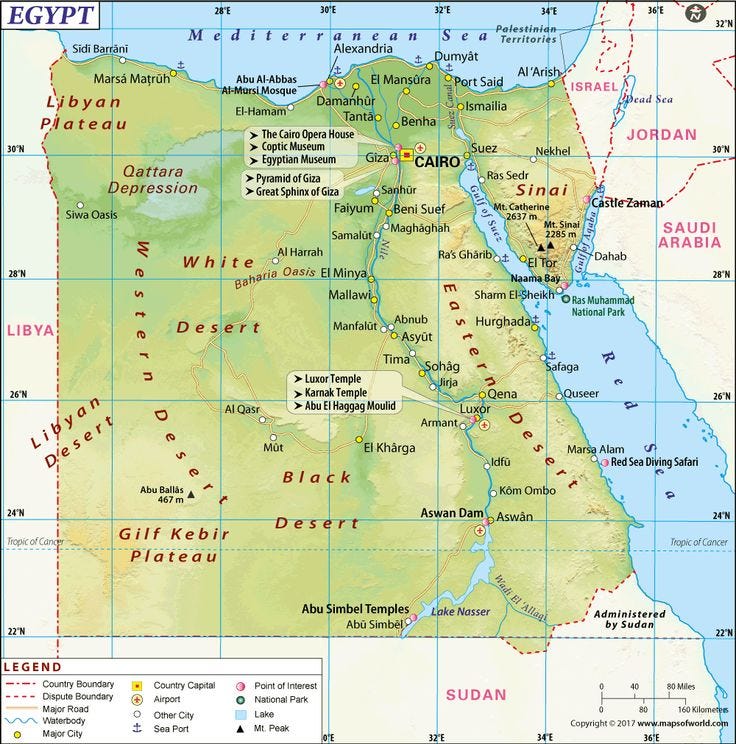
The country in question is Egypt. Instability in the region is one factor that often has a negative impact on Egypt. Since Oct 7th and the attacks by the Houthis in the Red Sea the Egyptian Economy has suffered due to the decline in the number of ships that transit through the Suez Canal.
During the recent G7 summit in France President Al-Sisi of Egypt attended the meeting and had a sidebar meeting with President Trump. The two leaders held talks on a variety of issues. A paragraph in the Egyptian Press Release was succinct: “The President emphasized Egypt’s commitment to further advancing and strengthening the ongoing strategic partnership between Egypt and the United States across various spheres, noting that these deep-rooted relations serve as a cornerstone for stability and peace in the region.”
Shortly after the conclusion of the G7 there were reports of Airstrikes by Egyptian Aircraft against RSF positions across Sudan. This shows a shift in the Egyptian position in the Sudanese conflict. Cairo has been one of the parties attempting to mediate between the two generals to achieve a ceasefire.
One source of regional tensions only merited two short sentences. “The two Presidents also deliberated on the water issue. President El-Sisi reiterated the ultimate importance of the Nile River issue as a matter of national security for Egypt.”
This issue addresses a major source of tensions in the region. Ethiopia has initiated the GERD project. This is a huge dam on the White Nile which provides hydroelectric power and water to Ethiopians while reducing the flow of water downstream. This has had a negative impact in both Sudan and Egypt.
There is a source of friction between Khartoum and Addis as well. On more than one occasion the RSF has launched drone strikes against SAF positions in Sudan. Once the SAF has retaliated with a strike against Ethiopia. There have been unsubstantiated rumors that if the Tigrayan People’s Defense Force enters a new conflict with the Ethiopian Military then the SAF may help the TPLF.
There also have been rumors of some reproachment between the United States and Eritrea as well. Eritrean President Afwerki was recently in Cairo. It may be possible that improving ties between Asmara and Washington may have been on the agenda.
One additional point to ponder. There is also a deployment of Egyptian troops into Somalia as well. There are several areas of concern. This move is a sign of warming ties between Cairo and Ankara. Secondly if (or should I say when) conflict breaks out in the region there is a sizable Egyptian force that could be deployed to assist their partners.
The more we ignore the Horn of Africa, the greater the chance of fighting breaking out.