
A new complication?
The Central African Republic may be drawn into the Sudan Conflict

We often hear that the Congo Wars in the late 1990s referred as Africa’s World War for the number of countries that intervened to support either the victorious insurgency or the struggling Congolese Government. Central Africa continues to feel the ramifications of that conflict to this very day.
It appears that the Sudan conflict is showing similar signals that were presented three decades ago in Congo. What began as a power struggle between two generals in Khartoum morphed into a civil war which has then further evolved into a proxy war with regional mid-level regional powers such as Egypt, the United Arab Emirates and Ethiopia now involved in the fighting.
We know that the Rapid Support Forces (RSF) led by General Hemeti has received copious assistance from the Emirates in recruiting and funding mercenaries from Colombia. In recent weeks the United States has sanctioned entities in Panama for creating this pipeline. However, the Sudanese Armed Forces (SAF) led by General Burhan reportedly undertook a covert operation where a team of the Sudanese Military travelled to Somalia and began training 5,107 fighters of the Somali National Army (SNA). It has been reported that 2,000 of the fighters whose training is being funded by Saudi Arabia are from Galmudug State. There are murmurings that these troops are being quietly sent to Sudan to bolster the SAF
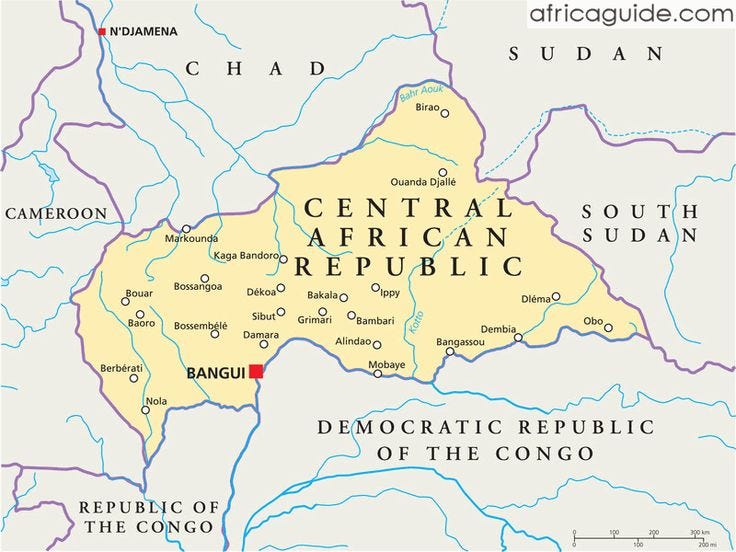
This is not the only direction that the conflict is spreading to either. In late June reports of clashes in the Central African Republic region near the Sudanese border emerged.
On June 30th an attack took place near the town of Am Dafock in the Vakaga prefecture. The positions of the Central Africa Armed Forces (FACA) and their Wagner Partners were overrun by 700 fighters from the Patriotic Action Alliance (Alliance du Sursaut Patriotique or ASP). This event was the most significant security incident along the Sudan-CAR border since 2023. The only reported casualties during the attack were the wounding of three UN Peacekeepers. The forces of FACA-Wagner would counterattack and recapture the town on July 5th.
We know that the ASP is a relatively new active group. It was founded in Mid-May 2026. Nourredine Adam, who is long standing Warlord in the country, is said to be actively recruiting for ASP. Haroun Gaye, another militant who was active with Coalition of Patriots for Change (CPC) is reportedly in charge of military operations. There are also reports that former members of Seleka were recruited for the assault on Am Dafock.
The ASP is believed to have launched this event to gauge the response of the FACA-Wagner alliance. This would be the most logical course of action as the UN Mission in CAR MINUSCA closed at least two dozen bases in the country last month. The reason cited was a reduction in funding for the mission by the United States. However, the bases in Vakaga prefecture are still staffed by UN Peacekeepers.
Another issue also presents itself. Did the RSF (Rapid Support Forces) in Sudan assist the ASP in this attack? This question presents some challenges to answer. There are ties between the RSF and the ASP. It has been reported that the RSF has recruited fighters from the group allied with Adam since 2023. Relations between the RSF and Wagner soured in 2024 when Moscow shifted its position from supporting the RSF with weapons and cash to supporting the Sudanese Armed Forces.
Another wrinkle that would support the RSF supporting this new group is that this could be payback. There were reports that Wagner fighters entered South Darfur and looted several villages. Darfur is the power base for the RSF, so a reprisal for these events should have been expected in CAR.
The question of whether this incident is a one-off or having the potential of removing an active supporter may be too early to answer, but the longer the conflict festers and affects the region, the longer and more complicated the peace process will be. This will further complicate the US efforts to negotiate a ceasefire.